





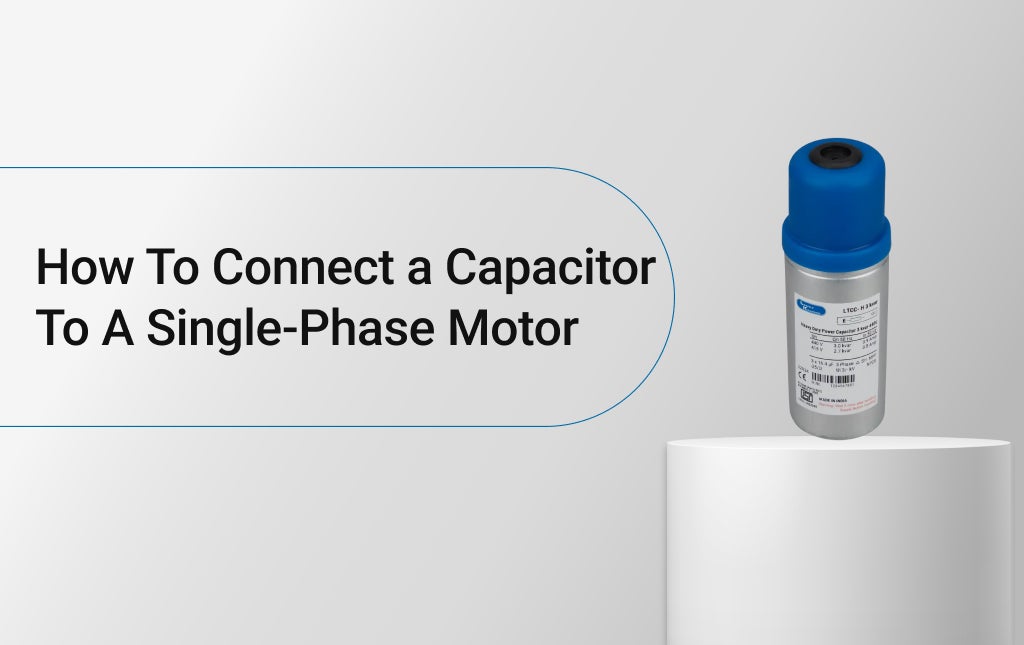
How To Connect a Capacitor To A Single-Phase Motor
Summary
Connecting a capacitor correctly is essential for the efficient operation of single-phase motors. Capacitors create the phase shift needed for motor startup, improve torque, and enhance efficiency. This guide explains capacitor types, wiring steps, capacitor selection, troubleshooting tips, safety precautions, and common applications of single-phase capacitor motors.
Key Takeaways
- Single-phase motors require capacitors to create a phase shift and generate starting torque.
- Start capacitors assist during motor startup, while run capacitors improve efficiency during continuous operation.
- Correct capacitor connection ensures smooth motor performance, reliability, and longer service life.
- Choosing a capacitor with the correct capacitance and voltage rating is critical for safe operation.
- Common motor issues such as slow running or failure to start are often linked to faulty or incorrect capacitors.
- Following proper wiring procedures and electrical safety precautions helps prevent equipment damage and electrical hazards.
Appliances like household items, as well as small machinery and industrial machines, make use of single-phase motors. Unlike self-starting three-phase motors, single-phase motors need an additional component to start them. This additional component is called a capacitor. Knowing how to connect the capacitor to a single-phase motor optimally will enhance equipment performance, its efficiency, and increase its life span.
In this blog, we will explore the basics of wiring single-phase motors, the need for motor capacitors, how to perform capacitor connections, and the significance of capacitors in single-phase capacitor-start motors. Let’s take a step forward.
Table of Contents
- Defining Single-Phase Motor Wiring
- Why Is A Capacitor Important For A Single-Phase Motor?
- Types of Capacitors Used
- Single Phase Capacitor Start Motor – How it Works
- Tools and Materials You Will Need
- How to Connect a Capacitor to the Motor - Step by Step
- Choosing the Right Capacitor
- Problems that Commonly Occur and Their Solutions
- Applications of Single-Phase Capacitor Motors
- Precautionary Steps
- Conclusion
Defining Single-Phase Motor Wiring
The phrase single-phase motor wiring involves a single-phase motor wiring, which operates on a single-phase power supply available in residential houses or smaller commercial sectors. The motors normally consist of two windings:
- Main Winding or Running Winding
- Auxiliary Winding or Starting Winding
Both of these windings are positioned at an angle of 90° with respect to each other electrically. But because of the single-phase AC supply, there is no initial phase shift between the currents flowing through these windings, which is required for the rotation of the motor. This is where the help of a motor capacitor comes in because it creates a phase difference.
Why Is A Capacitor Important For A Single-Phase Motor?
A very relevant question here is, why is a capacitor used in a single-phase motor? Because of a capacitor, a phase shift is introduced in the auxiliary winding, which makes the motor self-starting. The single-phase motor capacitor produces an effective rotating magnetic field when starting the motor.
Key Functions
- Generates a phase shift between the windings
- Aids in the starting torque
- Increases the efficiency of the motor
- Improves the power factor of the motor
Thus, the addition of a capacitor will vastly improve performance, while also proving that capacitor connection is imperative for the effective operation of single-phase motors.
Types of Capacitors Used
Before looking at how to connect capacitor to motor, it is important to understand what type of capacitor it is. In single phase capacitor start motor systems, two types of capacitors are usually found:
1. Start Capacitor
- High capacitance range (50 – 400 µF)
- Energized only during the starting phase
- Isosceles feature a discontinuous telecentric switch or Relay once the centrifugal motor reaches 70–80% of full speed
2. Run Capacitor
- Lower capacitance (5–50 µF)
- Active permanently
- Improves efficiency and performance
- Popular in continuous usage configurations of single-phase motor capacitors
Single Phase Capacitor Start Motor – How it Works
Both start and run capacitors are present in a single-phase-capacitor-start motor based on the use case. The start capacitor is responsible for high starting torque, while the run capacitor is responsible for maintaining efficient operational levels.
Here’s the simple principle:
- Power is delivered to both main and auxiliary windings.
- Induction Spark Gap develops a phase shift due to the motor capacitor, which leads to the creation of rotation.
- The start capacitor is disconnected after the operating speed is reached by the motor.
- Run, if present, the capacitor remains attached for better efficiency.
Tools and Materials You Will Need
To understand how to connect a capacitor to a motor, gather these basic tools:
- A multimeter to measure the value of the capacitor
- A wire stripper and cutter
- A soldering iron optional
- Electrical tape or wire connectors
- The capacitor fits the motor specifications.
How to Connect a Capacitor to the Motor - Step by Step
- Step 1: Identifying Wires
Identifying the wires for the main and auxiliary windings. Use a multimeter, resistance measurement, and an auxiliary winding that should have slightly higher resistance.
- Step 2: Connecting the Capacitor
For start capacitors, a connection with a centrifugal switch in series to the auxiliary winding, while for run capacitors, it should be in parallel to the auxiliary winding without a switch.
- Step 3: Connecting to Power
The main winding should be connected directly to the AC power lines. Make sure the rest of the connections are also insulated.
- Step 4: Safety Considerations
Using a multimeter, confirm the absence of a short circuit in any connection. If there is none, proceed to powering on the device.
- Step 5: Checking the Motor
Now that the power is on, the motor should rotate freely and smoothly, confirming all the connections are sound. Re-calibrate the wires and capacitor value if there is inadequate rotation.
Choosing the Right Capacitor
Selecting the correct single-phase motor capacitor is crucial. Look at the motor’s nameplate or datasheet for capacitance (µF) and voltage details. Installing a capacitor with the wrong specs will either destroy the motor or make it less efficient.
Tips:
- Always use motor-rated capacitors, not general-purpose.
- Over-voltage capacitors reduce life span.
- Protect capacitors with enclosures in dusty or humid areas
Problems that Commonly Occur and Their Solutions
Tips:
- Problem 1: Motor Hums but does not Start
Cause: Start capacitor is faulty or weak.
Solution: Replace with a new capacitor of the same rating.
- Problem 2: Motor Runs Slowly
Cause: Incorrect size motor capacitor.
Solution: Check and replace with correct capacitor.
- Problem 3: Capacitor Explodes or Smells Burnt
Possible Cause: Uses the wrong type of capacitor in overspec condition.
Solution: Use appropriate single phase motor capacitor.
Applications of Single-Phase Capacitor Motors
Capacitor motors have a high usage because of their uncomplicated nature and proven dependability. Some of the devices that use the motors include:
- Air Conditioners
- Refrigerators
- Pumps
- Washing Machines
- Ceiling Fans
- Compressors
Depending on the torque and performance requirements, these devices use either a single-phase capacitor start motor or a permanent split capacitor motor.
Precautionary Steps
Dealing with AC motors and working with capacitors has its inherent risk factors. Keep this in mind when you take these electrical safety procedures:
- Power must be turned off at the main source before any wires are touched.
- Touching the capacitor must be preceded by discharging it (capacitors store charge even when turned off).
- Gloves and insulated tools need to be used.
- The wiring diagram must be followed strictly.
Also Read: How to Choose the Right Motor Starter for Your Equipment
Conclusion
It's equally important to connect the capacitor as it is to ensure the single-phase motors function smoothly. Knowing how to connect a capacitor to a motor, what single-phase motor wiring is, and choosing the appropriate motor capacitor can enhance not just your machinery’s efficiency but also its durability.
No matter if it’s a problematic single-phase capacitor start motor or a new device being installed, remember to check the wiring diagrams as well as ensure that the correct capacitor connection is used and complete safety protocols are followed. With this information, you can now successfully perform the single-phase motor capacitor installation.

Comments