






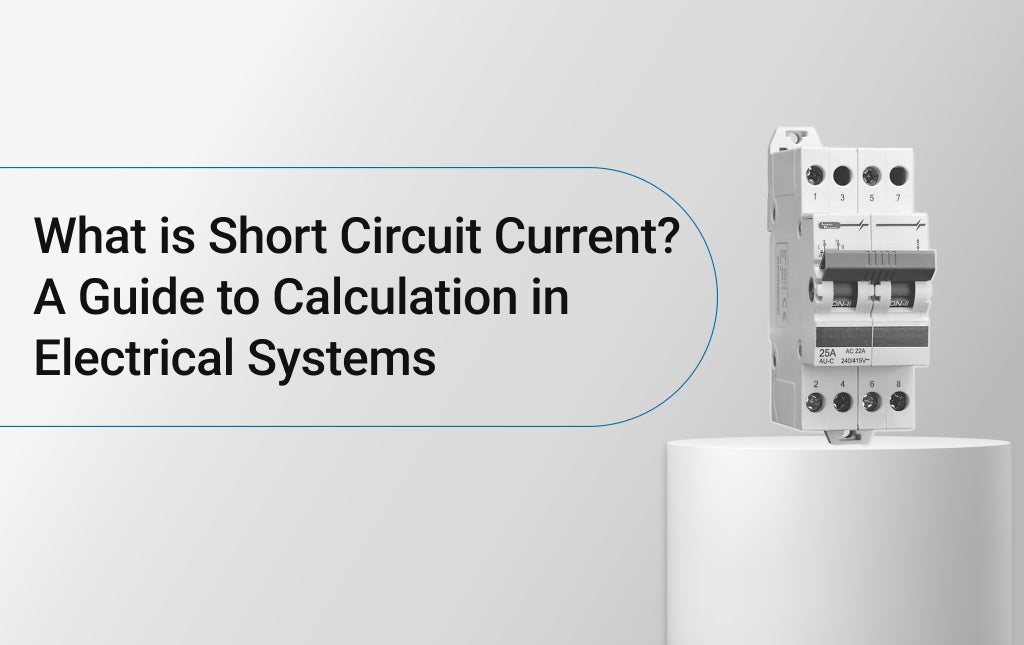
What is Short Circuit Current? A Guide to Calculation in Electrical Systems

An electrical system is a safe and efficient way to deliver energy. Nevertheless, faults such as short circuits can lead to the delivery of highly dangerous currents and become a threat to both equipment and personnel. Knowing what the short circuit current, its behaviour, and its calculation is essential for engineers, electricians and other professionals in the field of safety. This article provides the basics, the formulas, the methods for testing, and the applications for practical use that surround short circuit current calculation.
What is Short Circuit Current?
A short circuit current is a flow of current in a circuit that is abnormal, and it occurs as the result of a low-resistance pathway that has been formed unplanned. Put another way, current is short-circuited when electricity is allowed to bypass the load that has been designed for it, and suddenly, a surge of current is present.
What happens to the current in a short circuit?
• The current is allowed to rise uncontrollably, and it can be hundreds of times more than the operating current.
• Such excessive current can produce heat and sparks and cause destructive mechanical forces.
• The protective devices and circuit breakers will engage to try to isolate the fault and minimise potential hazards.
Short circuit currents are different from typical operating currents and are critical to overcurrent protection.
Difference Between Overcurrent and Short Circuit Current
Overcurrent and short circuit current are confused by many, but it is quite simple to distinguish:
| Feature | Overcurrent | Short Circuit Current |
|---|---|---|
| Definition | Current exceeding the rated value due to overload | Abnormally high current due to a low-resistance fault |
| Magnitude | Slightly above normal operating current | Extremely high, hundreds of times the normal current |
| Causes | Overload, equipment running beyond capacity | Phase-to-phase or phase-to-ground fault |
| Protective Action | Overcurrent relay trips | Circuit breaker trips immediately |
| Duration | Can last longer without damage | Needs immediate interruption to avoid catastrophic damage |
Understanding the difference between overcurrent and short circuit current is important to design proper protection systems.
How to Calculate Short Circuit Current
Short circuit current calculation is important for determining the size of circuit breakers, fuses, and other protective gear. This involves voltage, impedance, and other system parameters.
Short Circuit Current Formula
The fundamental short circuit current formula comes from the basics of Ohm’s Law:
Is = V / Z(total)
Where:
• Is – Short circuit current
• V – System voltage
• Z(total) – Impedance from the source to the fault point.
Z(total) consists of generator, transformer, line, and load impedances. Necessary to prevent device protection rating failures and equipment damage.
• Single-phase system: Is = VL / (ZL + Zs)
• Three-phase system: Is = VLL / (31/2Ztotal
Ztotal includes generator, transformer, line, and load impedances. Necessary to prevent protection rating failures and equipment damage.
Step-wise Short Circuit Current Calculation
• Identify System Parameters: Source voltage, transformer rating, impedances, line lengths, and load.
• Identify Fault Location: The Fault can shift the current either towards the source or the load.
• Get Total Impedance: Source and line impedance.
• Use the Formula: Is = V / Z(total); single-phase or three-phase.
• Cross-check the Equipment Ratings: Circuit short circuit current must be within the limits of the circuit breakers and fuses.
This methodology allows engineers to accurately calculate the short circuit current for any electrical system.
Short Circuit Variations
There are a number of ways in which short circuits can happen.
• Line-to-Line Fault: In this case, two phases come into contact with each other.
• Line-to-Ground Fault: One of the phases makes contact with the ground or a grounded surface.
• Three-Phase Fault: All three phases are shorted.
• Double Line-to-Ground Fault: Two of the phases come into contact with the ground at the same time.
Each of these cases impacts short circuit current in a unique way, so the different fault cases have to be used in the calculations.
Testing Short Circuit Current
To check whether the protection devices respond appropriately to the configured protection fault layers, you can test short circuit current in the following way.
• Test circuit break setup:
-
-
This is usually done in courses or by practitioners in the workplace with safety protections.
-
• Control Fault Current:
-
-
Use test instruments to create a temporary fault that is measurable.
-
• Relay and Breaker Monitoring:
-
-
Confirm that the circuit breakers can trip at the specified short circuit current top limit.
-
• Current Measurement and Validation:
-
-
This serves as the final check to be performed against calculated values. Registration of the results is the most essential part of this step.
-
Overall, these steps give a good indication of the safety and reliability of the entire system.
Short Circuit Current Influencing Factors
There are various reasons that explain the behaviour of current in a short circuit.
• Source Voltage: Higher voltages produce higher short circuit currents.
• System Impedance: More impedance reduces fault current.
• Fault Location: Higher currents are produced by faults closer to the source.
• Type of Fault: Normally, a three-phase fault occurs and generates the maximum fault current.
• Transformer Characteristics: The impedance of the transformer also limits the magnitude of the current.
These are the basic principles needed to calculate short circuit current and the coordination of protective devices.
Applications of Knowledge of Short Circuit Current
Calculating and knowing the short circuit current is pivotal for:
• Breaker Sizing: Certifying that circuit breakers can safely interrupt the fault.
• Fuse Choice: Ensuring selected fuses have the appropriate interrupting capacity.
• Protective System Design: Relay and protection devices system coordination.
• Fire Safety: Planning to protect the burn block and equipment from damage.
• Infrastructure Maintenance: Assessing the system/work for performance to upgrade it.
Enhanced short circuit current calculation improves all electrical systems for safety and reliability.
Safety Points
Short circuits produce serious risks. They can cause fires, damage to equipment, and to personnel. They can also be planes working at risk. Fire safety points:
• Ensure protection devices are calibrated to the calculated short circuit current.
• Maintenance and testing of breaker and relay systems.
• Insulated testers, tools, and PPE should be used.
• System parameters should be documented with updated fault calculation limits, and fault limits should be calculated regularly.
Also Read: How does Miniature Circuit Breakers protect from Overload and Short Circuits?
Conclusion
What, then, is short circuit current? It is defined simply as the surge of current that occurs when there is a short, low-resistance path, which could lead to damage or a risk if no measures are in place to control it. The short circuit current formula and its methods of calculation are crucial for engineers, as they determine the ratings for protective devices.
Being able to calculate short circuit current and knowing how to test short circuit current is vital in maintaining the safety of the system. Knowing the current behaviour in a short circuit is important for effective protective scheme design, while knowing the overcurrent versus short circuit current will offer effective device coordination.
Well-reasoned and accurate short circuit current calculation and protective measures will contribute to the safe, dependable, and low-risk operation of electrical systems.





Comments