






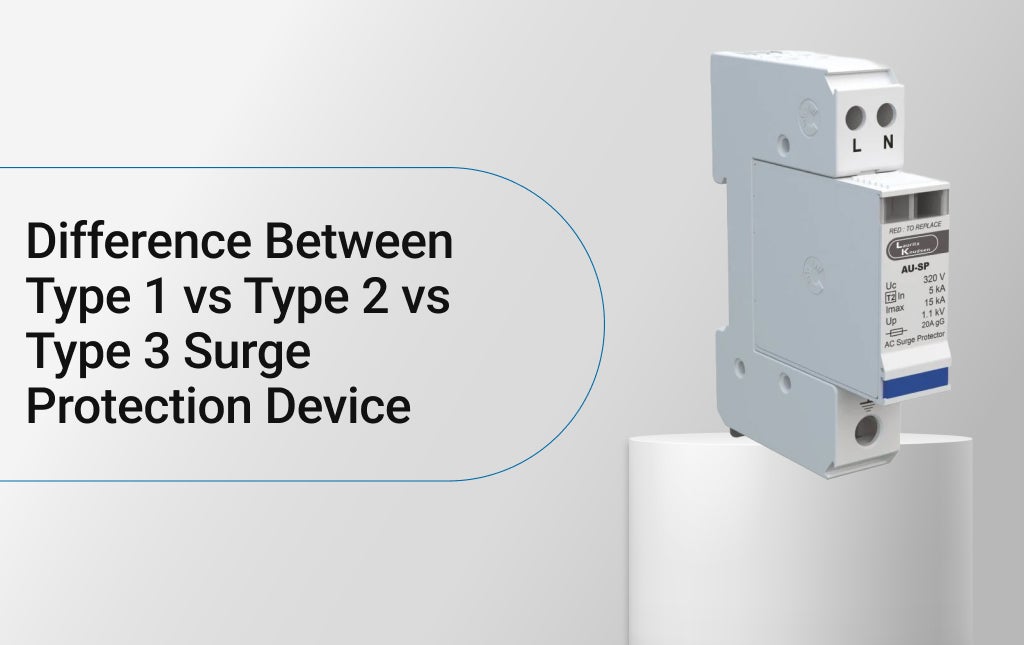
Difference Between Type 1 vs Type 2 vs Type 3 Surge Protection Device
Summary
Surge protection devices are sorted into three classes, and choosing the right one depends on where the device sits in the electrical system. This SPD types explained guide covers type 1 vs type 2 vs type 3 SPD, including testing waveforms, placement rules, impulse ratings and cascading coordination. It also compares SPD type 1 vs type 2 for service entrances and distribution boards, outlines point-of-use protection, and closes with a practical selection method for homes, commercial buildings and industrial plants.
Key Takeaways
- Type 1 SPDs handle high-energy lightning currents at service entrances, using the 10/350 µs test waveform.
- Type 2 SPDs protect distribution boards against residual lightning energy and switching transients using 8/20 µs.
- Type 3 SPDs provide point-of-use protection for sensitive equipment against residual transients and local voltage spikes.
- Cascaded Type 1, Type 2, and Type 3 protection progressively reduces residual voltage throughout the electrical installation.
- SPD selection depends on lightning exposure, internal loads, equipment sensitivity, impulse ratings, protection level, and installation location.
- Proper coordination, short connection leads, suitable backup protection, and effective earthing are essential for reliable surge protection.
Table of Contents
Introduction
Transient voltage spikes last only microseconds, yet they can wreck drives, servers and lighting drivers in a single event. Safeguarding residential, commercial and industrial electrical systems from these spikes is the core job of any surge suppressor. Classification follows UL 1449 in North America, IEC 61643-11 internationally, and NEC Article 285 for installation rules. Under these documents, surge protection device types fall into Type 1, Type 2 and Type 3, which correspond to Class I, Class II and Class III in IEC language. Think about it this way: Type 1 is the outer gate, Type 2 is the inner door, and Type 3 is the lock on the device itself. Each differs in location, test waveform and energy handling capacity.
Location & Cascading Topology: Type 1 2 3 SPD Network
Surge protection works as a layered defence rather than a single device. Each stage trims what the previous one allowed through. Placement along the supply path therefore matters as much as the ratings printed on the label, which explains why the coordinated type 1 2 3 SPD arrangement is used in an installation.
Coordinated Protection
Cascading stages lower residual voltage step by step, and the figure tracking this is the voltage protection level, written as Up. A Type 1 unit at the entrance may pass several kilovolts, a Type 2 stage trims that to about 1.5 kV to 2.5 kV, and a Type 3 stage brings it near 1 kV. In reality, coordination only works when decoupling inductance or sufficient cable length separates the stages.
Line Location Rules
Upstream and downstream placement relative to the main breaker and other overcurrent protective devices (OCPD) decides which type is permitted. Type 1 units can connect on the line side of the service disconnect, whereas Type 2 units belong on the load side. Type 3 devices follow further downstream. A line-side connection exposes the unit to full fault current, so listing and short-circuit current ratings need careful checking.
Detailed Comparison: Type 1 vs Type 2 vs Type 3 SPD
Differences between the three classes show up in test waveform, energy handling and mounting position. Reading them side by side clarifies why type 1 vs type 2 SPD choices change from one panel to the next, and why type 2 vs type 3 SPD decisions depend on the equipment being protected.
| Feature / Attribute | Type 1 SPD | Type 2 SPD | Type 3 SPD |
|---|---|---|---|
| Primary Location | Main Service Entrance (Line or Load Side) | Main / Distribution Sub-Panels (Load Side) | Point-of-Use Wall Sockets / Plug-in Strip |
| Waveform Tested | 10/350 µs (Direct Lightning) | 8/20 µs (Indirect / Switching) | Combination Wave (1.2/50 µs & 8/20 µs) |
| Impulse Current (Iimp / In) | High (Iimp 12.5 kA to 25 kA) | Moderate (In 20 kA to 40 kA) | Low (Uoc 6 kV to 10 kV) |
| Primary Protection Against | External direct lightning & utility transients | Internal motor switching & indirect lightning | Local residual transients & micro-spikes |
| Installation Requirement | Hardwired before or after main breaker | Hardwired at distribution board | Plugged into wall or integrated into appliance |
Deep Dive into Each SPD Class
Each class is built for a different job, and the construction reflects that. Type 1 devices rely on robust components for raw energy, Type 2 units balance capacity with low clamping voltage, and Type 3 devices prioritise precision. Details of each class follow in order, starting at the service entrance.
Type 1 Surge Protection Device: Main Service Barrier
A type 1 surge protection device is installed between the secondary of the service transformer and the main service breaker to defend against high-energy direct lightning strikes and utility switching. Testing uses 10/350 µs current impulses that simulate lightning current injection. Installation on the supply side of the main disconnect is possible without separate overcurrent protection. That makes the type 1 surge protection device the first barrier in the chain.
Type 2 Surge Protection Device: Distribution Panel Workhorse
A type 2 surge protection device sits on the load side of the main service entrance or in sub-distribution panels, where it absorbs residual lightning energy and internally generated inductive switching surges. Testing uses 8/20 µs current impulses. Inside, metal oxide varistors (MOVs) clamp fast transient spikes to limits that household and facility appliances can withstand. Most buildings rely on a type 2 surge protection device as the main working layer of defence.
Type 3 Surge Protection Device: Point-of-Use Defense
A type 3 SPD provides localised fine protection at the endpoint equipment, such as computers, televisions and medical devices, and must sit at least 10 meters of wire length from the distribution panel. Testing uses a combination wave generator delivering 1.2/50 µs voltage and 8/20 µs current. Products include plug-in surge strips, wall receptacle units and power supply suppressor modules. It handles little energy and relies on upstream stages for the bulk of a surge.
SPD Selection Guide
Selection starts with a clear picture of risk rather than a catalogue. Exposure to lightning, the nature of internal loads and the value of connected equipment settle the SPD type 1 vs type 2 question first, while endpoint needs decide the rest. A structured approach avoids both under-protection and unnecessary cost.
Identify Building Exposure
High-risk areas, including buildings fed by overhead power lines or fitted with external lightning rods, require a type 1 SPD at the service entrance. Ground flash density, line length and the height of the structure raise the chance of partial lightning current entering through the supply. Where a lightning protection system exists, IEC 62305 practice expects the surge path to be equipotentially bonded to the main earthing terminal.
Evaluate Internal Loads
Facilities with heavy motors, HVAC systems or industrial drives need a type 2 SPD at every sub-panel to trap switching transients. Starting and stopping inductive loads creates internal surges that originate inside the building, not on the utility line. For example, a compressor cycling on a distribution board can inject repeated spikes into neighbouring circuits, so local protection at each board limits the damage and extends equipment life.
Protect Critical Endpoints
Delicate medical, server or audio-visual gear requires localised type 3 SPD filters near the load. Residual transients that survive upstream stages, along with ringing created by long cable runs, can still disturb sensitive electronics. A plug-in strip or receptacle unit with a low voltage protection level therefore completes the cascade. Choosing a certified surge suppressor with a clear Up rating and thermal disconnect also reduces fire risk when the MOVs age.
Also Read: What is Surge Protector and How Does it Work?
Conclusion
Protection against transients is a layered plan rather than a single purchase. The type 1 2 3 SPD arrangement places high-energy devices at the entrance, working units at the panels and fine filters at the endpoint, so residual voltage falls at every stage. Anyone weighing type 1 vs type 2 vs type 3 SPD options should match the class to lightning exposure, load type and equipment value, then verify Iimp, In, Up and short-circuit ratings against the installation. This SPD types explained overview also shows why earthing quality matters as much as the device itself. For certified surge protection devices, MCBs, isolators and related electrical products, Lauritz Knudsen SmartShop offers a range for residential, commercial and industrial use, and every surge suppressor should be chosen against the actual ratings of the site.
FAQs
Q. How do surge protection device types map to IEC and EN classes?
Under IEC 61643-11 and EN 61643-11, Type 1 corresponds to Class I and is tested with Iimp, Type 2 corresponds to Class II and is tested with In and Imax, and Type 3 corresponds to Class III and is tested with Uoc. UL 1449 also lists Type 4 component assemblies and Type 5 discrete components, which are parts rather than standalone products.
Can one combined unit replace a separate type 1 vs type 2 SPD installation?
Combined Type 1+2 devices exist and suit compact premises, since they are tested with both 10/350 µs and 8/20 µs waveforms. A shortlist built from SPD type 1 vs type 2 datasheets should compare Iimp, In, Up and the maximum backup fuse rating. Enclosure space and available short-circuit current usually decide whether one combined unit is enough.
Q.How is the end of life of an SPD recognised?
Most modules include a status window that changes colour when the thermal disconnector operates, and many add a remote signalling contact for building management systems. Large surges can degrade metal oxide varistors without visible damage, so inspection after storms is useful. In type 2 vs type 3 SPD maintenance, panel modules are replaced as cartridges, while plug-in strips depend on a protection LED that is easy to overlook.
Q. Does type 2 vs type 3 SPD coordination need a minimum cable length?
Unless the manufacturer declares a coordinated pair, about 10 m of cable is commonly cited between Type 1 and Type 2 stages, and about 5 m between Type 2 and Type 3. Where the run is shorter, a decoupling inductor supplies the missing impedance. Any decision on type 1 vs type 2 SPD spacing should follow the datasheet.
Q. Does a type 1 SPD and a type 2 SPD need different backup protection and earthing?
In most cases, yes. Backup fuse or MCB values come from the datasheet, and Type 1 units usually accept larger fuses because of their higher impulse rating. IEC 60364-5-53 suggests a minimum earthing conductor of 16 mm² copper for Type 1 and 6 mm² copper for Type 2, with leads kept as short as
Comments