





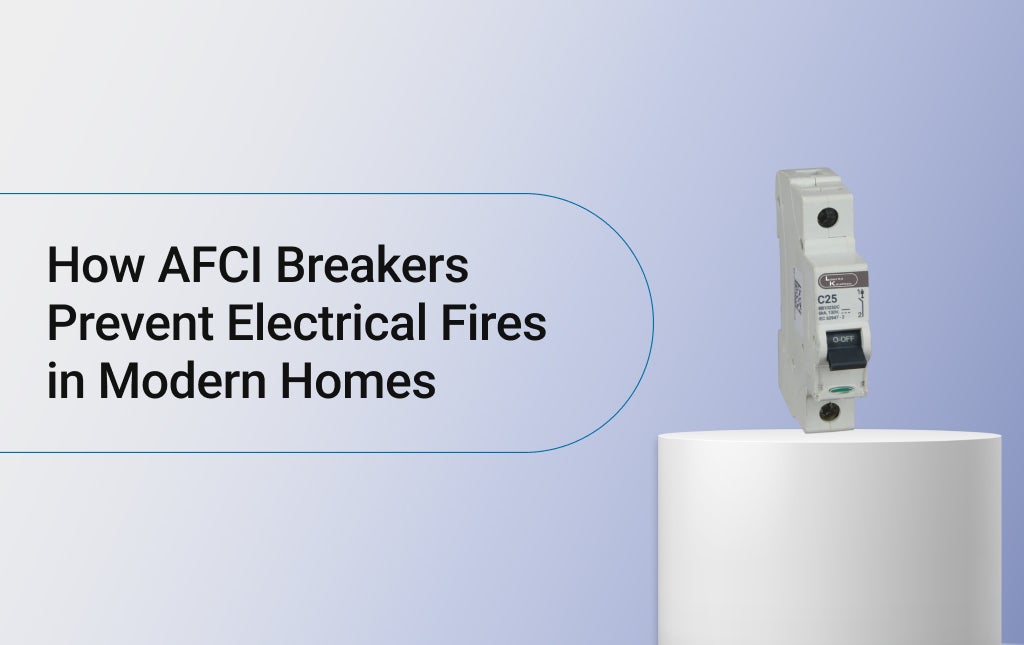
How AFCI Breakers Prevent Electrical Fires in Modern Homes
Modern homes today have never seen so many advancements in electricity. However, there's the flip side: compared to past decades, homes now pose greater risks. Because of the variety of appliances and hidden wiring throughout a home, as well as constant use of electricity, a minor malfunction can quickly develop into something much worse. The introduction of AFCI breakers helps mitigate those risks. For anyone unfamiliar with terms such as AFCI circuit breaker or who has questions about AFCI, this article explains how AFCI breakers work and why they're becoming more prevalent in homes today.
Table of Contents
- What is AFCI?
- What is an Arc Fault and Why Is It Dangerous?
- How Does AFCI Work?
- Types of AFCI Breakers
- AFCI vs MCB Circuit Breaker
- Is AFCI Better Than GFCI?
- How to Use Arc Fault Circuit Breakers
- AFCI Breaker Tripping: What Does It Mean?
- Why AFCIs Are Important in Modern Homes
- Advantages of Using AFCI Breakers
- Choosing the Right AFCI for Your Home
- How Lauritz Knudsen Smartshop Supports Electrical Safety
- Conclusion
- FAQ About Arc-Fault Circuit Interrupter
What is AFCI?
Let’s start with the basics.
AFCI full form is Arc-Fault Circuit Interrupter. It’s a safety device designed to detect dangerous electrical arcs and disconnect power before they can cause a fire. So, what is AFCI in simple terms? It’s a smart circuit breaker that identifies abnormal electrical patterns and stops them instantly. Unlike traditional protection devices, AFCIs focus specifically on arc faults, one of the leading causes of electrical fires.
What is an Arc Fault and Why Is It Dangerous?
Before understanding how AFCI works, you need to know what an arc fault is. An arc fault occurs when electrical current jumps between conductors instead of flowing through the intended path.
Common Causes of Arc Faults:
- Damaged or frayed wires
- Loose electrical connections
- Crushed or pinched cables
- Aging wiring systems
- Faulty appliances
These arcs generate intense heat that can ignite surrounding materials such as wood, insulation, or plastic. This is exactly what the arc fault circuit interrupter (AFCI) is designed to prevent.
How Does AFCI Work?
Now to the key question: how does AFCI work? An AFCI breaker continuously monitors the electrical current flowing through a circuit. It looks for irregular patterns that indicate an arc fault.
How AFCI Detects Problems:
- 1. Normal current flows through the circuit
- 2. The AFCI analyses the waveform of the current
- 3. It identifies abnormal fluctuations or arcing signatures
- 4. If detected, it trips immediately
- 5. Power is cut off before the arc can cause damage
This process happens in milliseconds. Unlike a standard mcb circuit breaker, which reacts to overloads or short circuits, AFCIs are designed to detect subtle faults that traditional breakers might miss.
Types of AFCI Breakers
There are different types of AFCI breakers, each designed for specific levels of protection.
1. Branch/Feeder AFCI
- Provides basic arc fault protection
- Installed at the panel level
2. Combination AFCI
- Offers advanced protection
- Detects both parallel and series arc faults
- Most commonly used in modern homes
3. Outlet Branch Circuit AFCI (OBC AFCI)
- Installed at the first outlet in a circuit
- Protects downstream wiring
4. Portable AFCI
- Used for temporary setups or testing
Choosing the right type depends on your installation and safety requirements.
AFCI vs MCB Circuit Breaker
Let’s clear up a common confusion.
MCB Circuit Breaker:
- Protects against overload and short circuit
- Reacts to high current
AFCI Circuit Breaker:
- Detects arc faults
- Prevents electrical fires
So, while both are important, they serve different purposes. An MCB circuit breaker won’t detect arc faults, which is why AFCIs are becoming increasingly important.
Is AFCI Better Than GFCI?
Another common comparison is whether AFCI is better than GFCI. The answer depends on what you’re trying to protect against.
AFCI:
- Protects against arc faults
- Prevents electrical fires
GFCI:
- Protects against ground faults
- Prevents electric shock
So, it’s not about one being better; it’s about using the right device for the right risk. In many modern installations, both AFCI and GFCI are used together for complete protection.
How to Use Arc Fault Circuit Breakers
Understanding how to use an arc fault circuit breaker is fairly straightforward.
Installation:
- Installed in the main distribution board
- Replaces standard circuit breakers
Operation:
- Works automatically
- No manual intervention required
Maintenance:
- Periodically test using the test button
- Ensure proper wiring and connections
Once installed, it continuously monitors your system without needing attention.
AFCI Breaker Tripping: What Does It Mean?
If you’re experiencing an AFCI breaker tripping, it’s important to understand why. Unlike random trips, AFCI tripping usually indicates a potential hazard.
Common Causes:
- Loose wiring connections
- Damaged insulation
- Faulty appliances
- Overloaded circuits with unstable current patterns
What Should You Do?
- Check connected devices
- Inspect wiring
- Avoid ignoring repeated tripping
Frequent AFCI tripping is a warning sign, not something to bypass.
Why AFCIs Are Important in Modern Homes
Modern homes are very different from older ones.
- More Appliances: From smart TVs to kitchen equipment, power demand is higher.
- Hidden Wiring: Most wiring is concealed behind walls, making faults harder to detect.
- Continuous Usage: Devices run for longer durations, increasing wear and tear.
- Fire Risks: Even a small arc can lead to serious damage.
This is why the AFCI circuit breaker is becoming a standard requirement in many regions.
Advantages of Using AFCI Breakers
Here’s why AFCIs are worth considering:
- Fire Prevention: They detect arc faults before they escalate.
- Advanced Detection: They identify issues that traditional breakers miss.
- Increased Safety: Protects both property and lives.
- Compliance with Modern Standards: Many safety regulations now recommend AFCIs.
Choosing the Right AFCI for Your Home
Not all setups are the same.
Consider:
- Type of wiring system
- Load requirements
- Compatibility with the existing panel
- Combination with GFCI if needed
Proper selection ensures optimal performance.
How Lauritz Knudsen Smartshop Supports Electrical Safety
Today, due to increased demand for electrical safety, it requires far more than standard protection. Lauritz Knudsen Smartshop offers advanced electrical protection products for evolving electrical needs, featuring advanced technology circuit breakers. This includes providing consumers with an option to transition from traditional MCB circuit breakers or to improve their electrical safety system. The platform offers several high-quality, durable circuit breakers that deliver reliability and performance. As a consumer, when dealing with risks such as arc faults, selecting high-quality parts is not merely a suggestion; it's a necessity.
Also Read: Circuit Breaker: Types, Uses, and Applications
Conclusion
Knowing what AFCI is and how it works provides consumers with a better understanding of modern electrical safety. AFCI breakers are not just another advancement; they identify and address a genuine risk that many people do not realise exists. By identifying arc faults at an early stage, AFCI breakers eliminate the risk of electrical fires before they occur.
With increasing complexity in home electrical systems, simply relying on conventional safety measures is no longer sufficient. In addition to ensuring your electrical system is functional, adding AFCI protection will ensure it is safe.
FAQ About Arc-Fault Circuit Interrupter
Q. What is AFCI, and why is it important?
Ans. What is AFCI? It stands for Arc Fault Circuit Interrupter. It is important because it identifies dangerous arc faults and eliminates the risk of an electrical fire, which could pose a hazard to you and others. Therefore, it is one of the most vital safety devices available today for protecting your family.
Q. How does AFCI work in simple terms?
Ans. If you want to know how AFCI works, it checks the flow of electrical current for irregularities that could cause arcing. Once it identifies an arc fault, it immediately disconnects power, preventing any possible fire hazard.
Q. What are the different types of AFCI breakers?
Ans. There are four primary categories of AFCI breakers: Branch AFCI, Combination AFCI, Outlet Branch Circuit AFCI, and Portable AFCI. Each category provides varying degrees of protection.
Q. Why does an AFCI breaker keep tripping?
Ans. An AFCI breaker may trip due to loose wiring, damaged insulation, or malfunctioning appliances. The above factors indicate potential problems and therefore cannot be ignored.
Q. Is AFCI better than GFCI?
Ans. When comparing AFCI versus GFCI, both are good safety devices. However, they each serve a different purpose. AFCI breaks circuits to prevent electrical fires from occurring. GFCIs protect individuals from receiving an electric shock. Often, both are used in conjunction.
Comments