






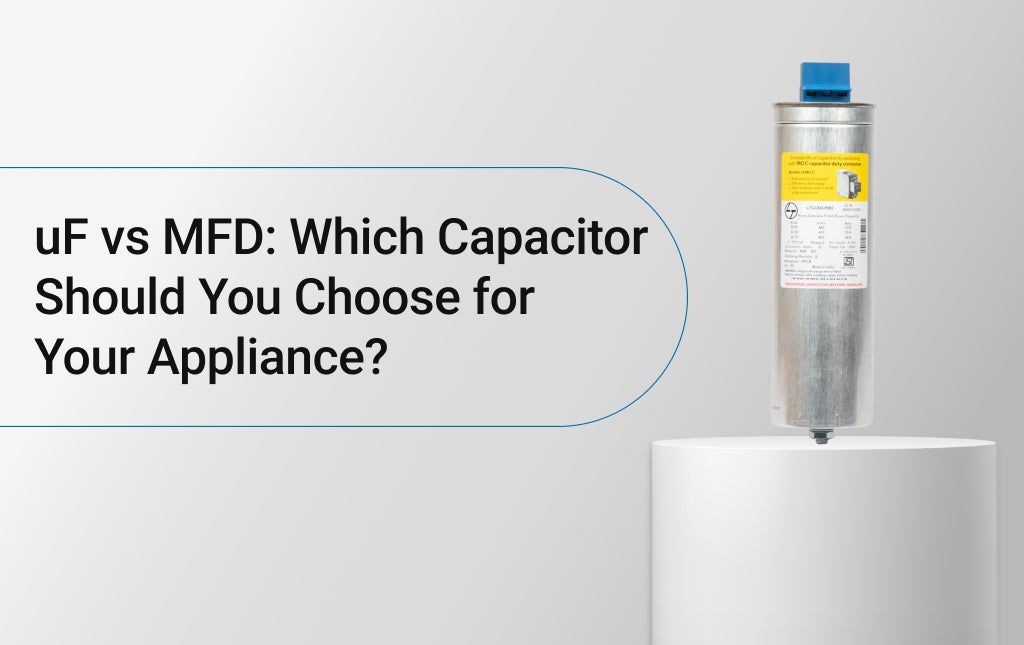
UF vs MFD: Which Capacitor Should You Choose for Your Appliance?

Table of Contents
If you have ever opened up a fan, AC unit, or pump and looked at the capacitor, chances are you noticed markings like uF or MFD. For many people, that’s where confusion starts. Are these two different things? Do they behave differently? Or is this just another case of electrical terminology making things harder than they need to be?
In reality, the uF vs MFD question exists mostly because of how components have been labeled over the years. Appliances don’t really care what letters are printed on the casing. They care about correct values. Once that idea clicks, capacitor selection becomes much simpler.
What is MFD Capacitor?
To understand what is MFD capacitor, it helps to look at older electrical equipment. MFD is an older way of writing microfarad, which is a unit used to measure capacitance. In simple terms, it tells you how much electrical charge the capacitor can hold and release when the appliance is running.
When people talk about what is MFD capacitor, they are usually referring to motor capacitors used in air conditioners, water pumps, ceiling fans, and compressors. These capacitors help the motor start and keep running smoothly. If the value is wrong, the motor may struggle, overheat, or fail early.
The MFD capacitor full form is microfarad. It represents one-millionth of a farad. Years ago, manufacturers commonly used “MFD” because printing the Greek µ symbol was inconvenient. Even today, many older appliances still list values using this format, which is why the MFD capacitor full form continues to show up on replacement parts and manuals. Electrically, nothing changes.
The capacitor MFD formula is often mentioned when selecting motor capacitors, especially when original values are missing. It relates motor power, voltage, and frequency to capacitance.
What is a UF Capacitor?
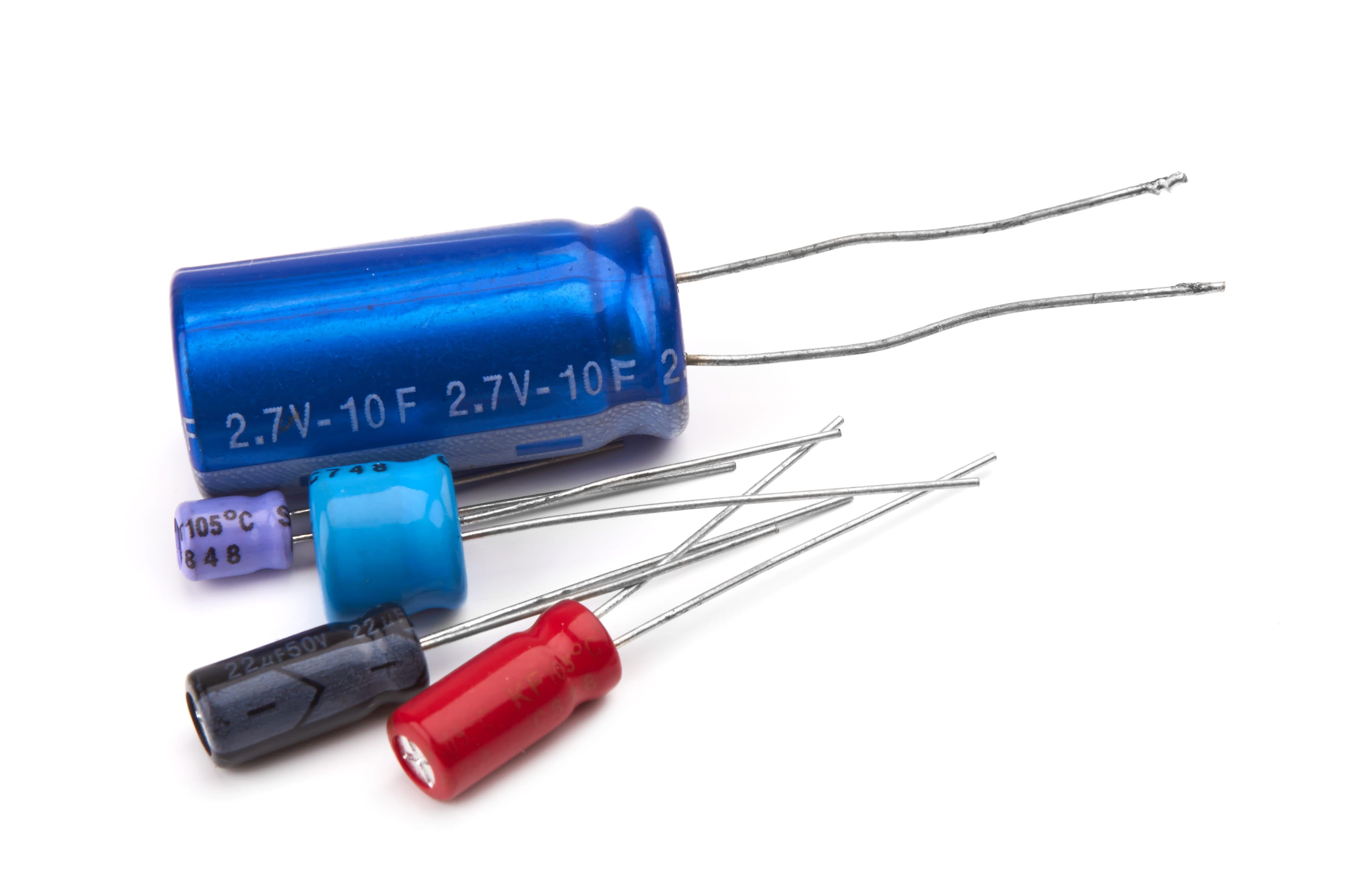
Now let’s talk about the other label. What is uF capacitor? A uF capacitor is simply a capacitor whose value is written as µF instead of MFD. That’s it. No change in design, no change in performance.
Over time, uF became the standard notation. Understanding what is uF capacitor helps avoid the assumption that uF-rated parts are somehow different or incompatible with MFD-rated ones.
The uF capacitor full form is microfarad, written using the µ symbol. This format is now used almost everywhere- datasheets, testing instruments, circuit diagrams, and appliance specifications.
Knowing the uF capacitor full form makes it easier to read modern documentation without second-guessing compatibility. Once you recognize that uF and MFD mean the same thing, the confusion stops.
Difference Between uF and MFD Capacitors
People often look for a clear technical differentiation here, but the difference between uF and MFD capacitors is more about context than function. Below are the real-world factors that create the confusion.
|
Comparison Factor |
uF Capacitor |
MFD Capacitor |
|
Full Form |
Microfarad |
Microfarad (Older abbreviation) |
|
Labeling Standard |
Modern international labeling standard |
Older labeling format used in vintage equipment |
|
Usage Era |
Common in modern appliances, HVAC systems, and electronics |
Mostly found in older appliances, motors, and legacy systems |
|
Electrical Function |
Stores and releases electrical charge |
Stores and releases electrical charge |
|
Documentation Reference |
Used in newer manuals and service guides |
Found in older technical manuals and equipment documents |
|
Market Availability |
Widely available and commonly manufactured today |
Limited availability, mostly in older stock or specialized components |
|
Replacement Compatibility |
Can directly replace MFD capacitor if rating matches |
Can be replaced with uF capacitor of the same rating |
|
Technician Preference |
Preferred by modern technicians due to standardization |
Preferred by technicians familiar with older systems |
|
Industry Standardization |
Follows current SI unit abbreviation |
Pre-standard abbreviation used historically |
uF vs MFD: Which one should you choose?
When deciding uF vs MFD, the correct choice is the one that matches your appliance specifications. Motors do not read labels. They respond to capacitance value and voltage rating.
If the original capacitor says MFD and you find a uF replacement with the same numbers, it will work. The uF vs MFD debate matters far less than correct ratings. In practical repairs, uF vs MFD is a question of interpretation, not technology.
How to calculate uF Capacitor when specs are missing?
When the capacitor value isn’t visible anymore, there usually isn’t a clean answer. In real situations, people don’t sit down and calculate a perfect number. What actually happens is a mix of judgment, comparison, and trial. The value is narrowed down slowly, not solved in one go, and the appliance itself ends up confirming whether the choice makes sense. Below are the steps to follow when learning how to calculate uF capacitor.
Step 1: Look at the job the Capacitor is doing
The first thing to notice is why the capacitor exists there at all. A capacitor sitting in a fan circuit is doing a very different job compared to one connected to a pump or compressor. Light-duty appliances simply don’t need large uF values. Heavier motors do. This single observation already removes a lot of unrealistic options without touching any numbers.
Step 2: Let the Motor give you Clues
Even if the capacitor details are gone, the motor usually isn’t silent. Voltage rating, power label, and even how bulky the motor looks give hints. Motors that work harder generally need more help from the capacitor. This step isn’t about precision. It’s about understanding whether the value should be small, medium, or clearly on the higher side.
Step 3: Compare with Common Real-World Ranges
Most appliances don’t vary as much as people think. Fans tend to repeat similar uF values. Pumps do the same. After seeing enough of them, certain ranges start feeling familiar. Comparing the unknown appliance to something you have already seen is often more useful than relying on formulas, especially when dealing with older or mixed-brand equipment.
Step 4: Stay Slightly Conservative at First
Jumping straight to a high value is rarely a good idea. A capacitor that’s a bit low will usually show obvious signs without causing damage. A capacitor that’s too high may stress the motor quietly. This is why many people start smaller and only move up if needed. It’s slower, but it’s safer for the appliance.
Step 5: Watch how the Appliance Responds
In the end, the appliance tells you everything. If it starts smoothly, runs steadily, and sounds normal, the capacitor is probably close enough. If it struggles, hums, or heats up strangely, the value isn’t right. This feedback matters more than calculations, because it reflects how the system actually behaves under load.
How to check MFD on a Capacitor?
Knowing how to check MFD on a capacitor is one of the most practical skills during appliance repair. A digital multimeter with capacitance mode makes the process simple.
Step 1: Make sure power is actually gone
Before touching anything, pause and double-check that the appliance is truly disconnected. Not just switched off but fully isolated. Unplug it, or cut power at the main source. Many issues happen when people rush this step. Capacitors don’t care if you think the power is off, so it’s worth double checking.
Step 2: Clear any remaining charge
Even with power removed, a capacitor can still hold energy. Use something insulated to discharge it briefly. This step doesn’t take long, but skipping it can damage tools or cause a sharp surprise, especially with larger appliance capacitors.
Step 3: Loosen it from the Circuit
Trying to test a capacitor while it’s still fully connected usually leads to odd readings that don’t make sense. Other components interfere. Disconnecting at least one terminal is usually enough. Take note of where the wires go before removing anything. It saves confusion later when everything needs to go back together.
Step 4: Set the Meter and don’t rush it
Turn the multimeter to the capacitance setting, which may be marked as µF or MFD depending on the meter. If the meter has ranges, start higher than expected. Give the meter a moment. It doesn’t always respond instantly, and rushing this part often leads to misreading the display.
Step 5: Touch the Probes and Hold Steady
Place the probes on the capacitor terminals and keep them there. The numbers may move briefly before settling. Poor contact or shaky hands can cause jumping readings, so it helps to stay still and let the meter finish doing its thing before drawing conclusions.
Also Read: What Are Supercapacitors? Types and Applications
Conclusion
Once you stop treating uF and MFD as competing terms, capacitor selection becomes straightforward. They describe the same unit, measured the same way, and used for the same purpose. What matters is matching the right value and voltage to the appliance.
Whether you’re replacing a motor capacitor, checking ratings, or working with PF correction capacitors, understanding labels removes unnecessary confusion and that alone prevents many common electrical mistakes.
FAQ's
Q1. Does the capacitor value really affect how much power an appliance uses?
Ans: Not in a way that’s easy to notice. Things don’t suddenly spike or shut down. What usually happens is the appliance just feels a bit heavier in operation. Over time, that extra effort adds up. It’s subtle, not dramatic, which is why people often miss it.
Q2. Is a higher voltage capacitor actually a problem?
Ans: Most of the time, no. A higher voltage rating just means the capacitor is built to handle more than what it’s seeing. The appliance doesn’t force extra voltage into it. Issues usually start when the capacitance itself isn’t right, not because the voltage rating was higher.
Q3. Can a capacitor go bad even if nothing is really used much?
Ans: Yes, that happens. Time alone does damage. Heat in the environment, storage conditions, and age all play a role. So even something that sat quietly for years can still act up later, which feels odd but is pretty common.
Q4. Why do some bad capacitors look completely normal?
Ans: This is because not all failures are visible. Some just stop doing their job properly inside. Nothing leaks, nothing swells. The appliance just behaves strangely, and that’s usually the only clue something is off.
Q5. Is it okay to swap one capacitor between appliances just to see if it works?
Ans: People do it when they are stuck, but it’s not something to leave in place. An appliance might run, but that doesn’t mean it’s happy. It’s fine as a quick check, but keeping it that way usually causes problems later.


Comments