



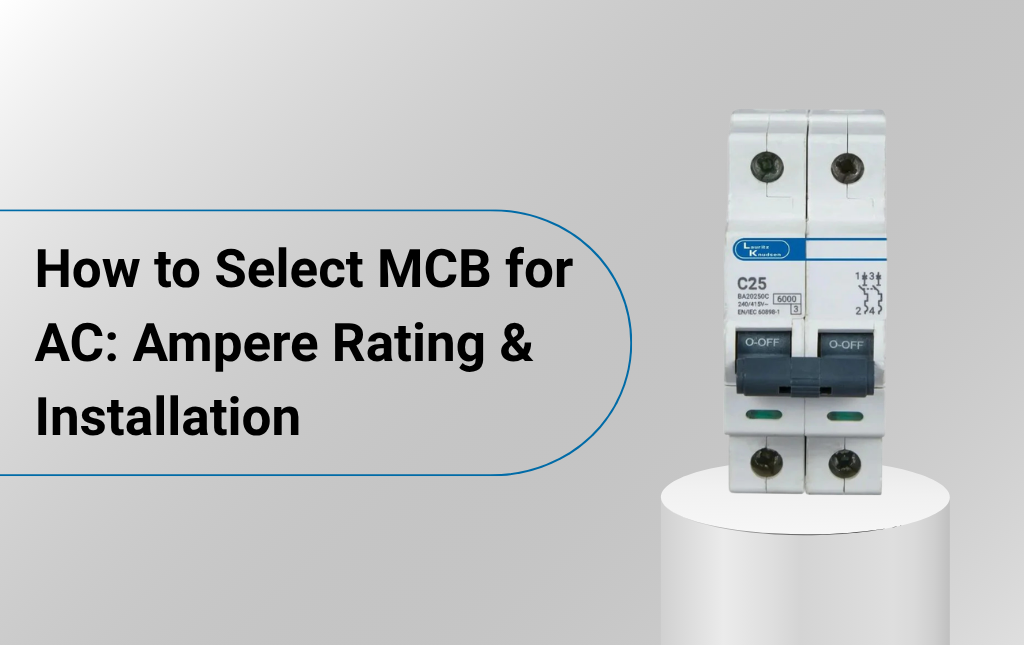
How to Select MCB for AC: Ampere Rating & Installation Guide

You buy an air conditioner, get it installed, and expect it to just work. Smoothly. Silently. Safely. But behind that comfort, there’s a small device quietly taking the responsibility of protecting everything- your wiring, your AC, even your home. That device is the MCB for AC.
Choosing the right MCB for AC isn’t as straightforward as picking any switch from the market. It depends on load, starting current, and even the type of AC you are using. An AC draws a sudden surge of current when it starts. If your MCB can’t handle that, it trips. Too often. Too randomly. And that’s where understanding selection and installation really starts to matter.
Table of Contents
What is MCB for AC?
Let’s keep this simple. An MCB, or Miniature Circuit Breaker, is a protective device that automatically cuts off electricity when it detects an overload or short circuit. In the case of an air conditioner, this becomes especially important because ACs don’t draw a steady current. They fluctuate, especially during startup.
Now, is MCB required for AC? Honestly, it’s not even optional. Without it, a sudden fault could damage the compressor or even cause wiring to overheat. AC wiring is not something you want to take lightly.
Selecting the correct MCB ampere for AC isn’t just about matching the AC’s power rating. You also need to consider starting current, cable size, and supply conditions. For example, a 1.5 ton AC might run comfortably on a certain current, but during startup, it briefly demands much more.
In larger setups or commercial spaces, you may even see an MCCB being used instead of a regular MCB because of higher load requirements. But for homes, a properly chosen MCB usually does the job perfectly, quietly and efficiently.
Types of MCB for AC
Not all MCBs behave the same way. Some trip faster, some tolerate brief surges, and some are designed specifically for motor-driven appliances like air conditioners. Understanding these types helps you avoid unnecessary tripping and ensures your AC runs without interruptions.
1. Type B MCB
Type B MCBs trip quickly when current exceeds a low multiple of their rated value. They are usually used in lighting circuits or appliances with minimal surge current. But here’s the catch- ACs are not gentle starters. They draw a surge when the compressor kicks in. So, using Type B for AC might lead to frequent tripping. That’s why it’s rarely recommended when deciding which MCB is best for 1.5 ton AC.
2. Type C MCB
Type C is the most commonly used MCB for air conditioners. It can handle moderate surge currents without tripping instantly. In reality, this makes it ideal for compressor-based loads. It gives your AC the flexibility to start smoothly while still protecting against faults. When people ask about the right MCB required for 1.5 ton AC, Type C usually becomes the practical answer in most residential setups.
How to Select MCB for AC
This is where most people get confused. Selection isn’t about guesswork. It’s about understanding how your AC behaves electrically. Load, starting current, and wiring all come into play. Get this right, and your system runs smoothly. Get it wrong, and you will deal with constant tripping or, worse, no protection at all.
1. Consider AC Capacity and Load
Start with the tonnage. A 1 ton, 1.5 ton, or 2 ton AC all have different current requirements. But here’s something people miss- startup current is higher than running current. That’s why selecting the correct MCB ampere for AC matters. For example, a 1.5 ton AC typically runs around 70 10 amps but may need a 16A or 20A MCB to handle startup load. That’s how you decide which MCB is best for 1.5 ton AC and others.
2. Choose the Right MCB Type
Type matters just as much as rating. ACs have compressors, and compressors draw surge current. So, a Type C MCB is usually preferred because it tolerates that brief spike without tripping unnecessarily. This is where practical thinking beats theory.
3. Check Power Supply and Voltage Stability
Now think about your actual supply conditions. Is your voltage stable, or does it fluctuate? In many Indian homes, voltage drops are common. When voltage drops, current increases and that can affect your MCB performance. So, while selecting your MCB for AC, factor in real-world conditions, not just ideal ratings. Sometimes, slightly adjusting your selection prevents frequent and frustrating tripping.
4. Consider Cable Size and Wiring
Your wiring matters as much as the MCB itself. If the cable size is too small, it heats up even under normal load. And no MCB can fix poor wiring choices. Typically, a 2.5 sq mm or 4 sq mm copper wire pairs well with a 16A- 20A MCB for most AC units. This directly impacts the safety of your MCB connection for AC, making the setup more reliable.
5. Future Load and Safety Margin
Think ahead for a moment. What if you upgrade your AC later or add more load to the same circuit? Choosing an MCB with a small safety margin helps avoid immediate replacements. But don’t overdo it. An oversized MCB won’t trip when it should. The goal is balance- enough capacity to handle surges, but sensitive enough to protect. That’s how smart selection actually works in real situations.
MCB Working Principle for AC
At its core, an MCB follows a simple idea- detect excess current and disconnect the circuit. But the way it balances speed and tolerance is what makes it suitable for appliances like air conditioners.
1. Overload Protection
When your AC runs continuously under higher-than-normal load, the thermal mechanism inside the MCB gradually heats up and trips. This avoids damage over time. For example, if voltage drops and current increases, your AC struggles. The MCB steps in. This is also why understanding which MCB is best for your AC helps in preventing nuisance tripping while maintaining safety.
2. Short Circuit Protection
A short circuit is sudden and dangerous. The magnetic mechanism inside the MCB reacts instantly, cutting off power. There’s no delay here. No warning. Just immediate action. And honestly, this is where an MCB proves its real value. Without it, faults could escalate quickly. That’s exactly why people ask is MCB required for AC- because it protects against the worst-case scenarios.
Installation Steps for MCB for AC
Installation isn’t complicated, but it does require attention to detail. A loose wire or wrong connection can defeat the entire purpose of protection. So even if it seems simple, it’s worth understanding the steps before you actually get it done.
Step 1: Turn Off Power Supply
Before anything else, switch off the main power supply. This isn’t optional, it’s essential. Working on a live circuit is dangerous, even for experienced electricians. Once power is off, you can safely proceed. People often rush this step, but in reality, safety comes first. If you are learning how to install MCB for AC, this is where it begins- by eliminating risk completely.
Step 2: Proper Wiring Connection
Connect the phase wire through the MCB and ensure neutral and earth connections are properly secured. This is where accuracy matters. A loose or incorrect MCB connection for AC can lead to heating or malfunction. Take your time here. Tight connections, correct terminals, and proper cable size- all of it adds up to reliable performance.
Also Read: MCB (Miniature Circuit Breakers) Guide - Types, Sizes, and Uses
Conclusion
Choosing the right MCB for your AC isn’t just a technical step. It’s a safety decision. From selecting the correct type to ensuring proper installation, each choice affects how well your system performs over time. If you are looking for reliable solutions, Lauritz Knudsen SmartShop offers a range of trusted electrical products designed for durability and safety, making your selection process a lot easier.
FAQs
Q. Can I use a 20A MCB for a 1 ton AC?
Ans. It depends on the AC specifications, but usually 16A or 20A works. Always verify load details before deciding.
Q. Why does my AC trip the MCB repeatedly?
Ans. This could be due to incorrect MCB type, wrong rating, or internal AC issues like compressor faults.
Q. Is Type C always recommended for AC?
Ans. In most residential cases, yes. It handles surge current better than Type B.
Q. Can I connect AC directly without MCB?
Ans. Not advisable. It increases the risk of damage and electrical hazards significantly.
Q. What happens if wiring is loose in MCB?
Ans. Loose connections can cause overheating, sparking, and eventual failure of both wiring and MCB.





Comments