





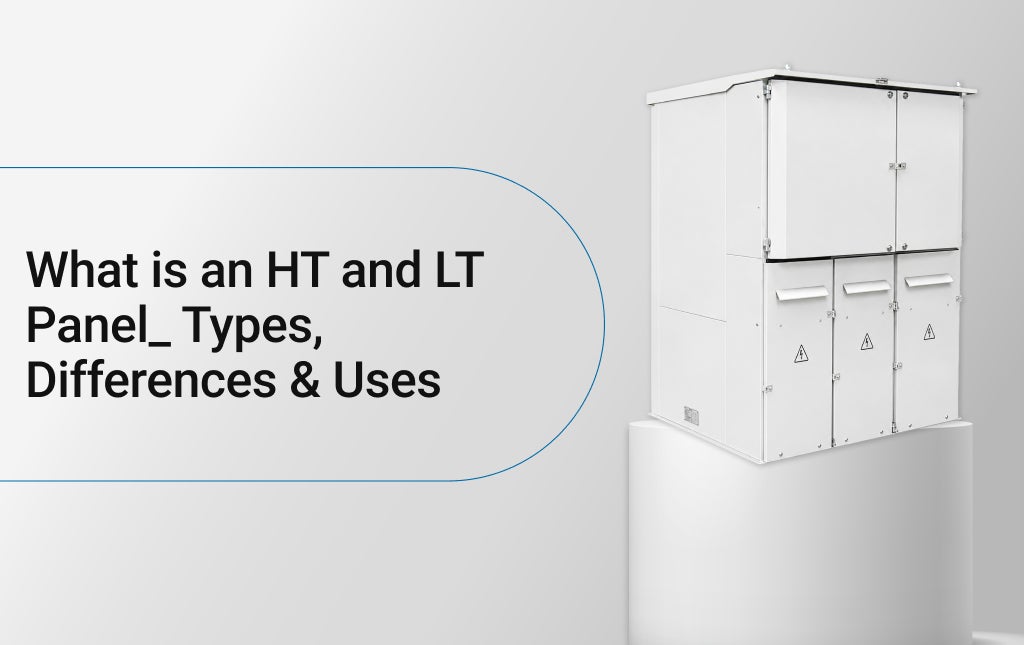
What is an HT and LT Panel? Types, Differences & Uses
Summary
An HT panel handles high voltage power from the grid. An LT panel brings that power down to a level equipment can use. The LT panel full form is Low Tension Panel, and the HT panel full form is High Tension Panel. Together, they keep factories and homes running, working with a Distribution Board that splits power into usable circuits.
Key Takeaways
- HT panels manage voltages above 11kV from the grid.
- LT panels handle voltages under 1000V, close to where equipment runs.
- Both ht and LT panels rely on breakers, relays, and busbars to stay safe.
- There are several types of HT panels and types of LT panels, each suited to a different job.
- A solid HT panel maintenance checklist and LT panel maintenance checklist prevent costly downtime.
- The difference between ht and LT panel systems comes down to voltage and use, and both eventually feed into a Distribution Board.
Table of Contents
- Introduction
- Understanding Electrical Power Distribution Panels
- What is an HT (High Tension) Panel?
- Common Types of HT Panels
- Primary Applications & Use Cases of HT Panels
- HT Panel Maintenance Checklist
- What Is an LT (Low Tension) Panel?
- Common Types of LT Panels
- Primary Applications & Use Cases of LT Panels
- LT Panel Maintenance Checklist
- Difference Between HT and LT Panel
- Conclusion
- FAQs
Introduction
New to electrical infrastructure? You've probably wondered what is HT panel and what is LT panel. Walk into any large factory, and somewhere behind a locked door, panels are humming away, quietly keeping machines and lights running. This article breaks it all down, plainly and without jargon overload.
Understanding Electrical Power Distribution Panels
Power doesn't just show up ready to use. It travels in stages, each needing its own switchgear. Switchgear is the protective layer of any power network. It isolates faults fast and stops overloads before they spread. Without it, a single fault could cascade through an entire facility, taking down equipment far from the original problem.
An HT panel deals with voltages above 11kV. An LT panel handles anything below 1000V. Knowing the HT panel full form and LT panel full form, High Tension and Low Tension, makes the difference easy to remember. Once that distinction sticks, most panel-related confusion in day-to-day site conversations tends to clear up fast.
What is an HT (High Tension) Panel?
So, what is HT panel exactly? The ht panel full form, High Tension Panel, says it plainly. It's a switchgear enclosure built for high voltage, usually above 11kV and up to 33kV. These panels sit where bulk power enters a site, before anything gets stepped down.
Think of it like a security checkpoint at a large campus. HT panels work the same way, rugged and often metal-clad, because high voltage doesn't forgive mistakes. Steel plants, cement factories, and hospitals all lean on solid HT infrastructure.
Common Types of HT Panels
Not every HT panel does the same job. The right type depends on space and how the network is built. Here are the types of HT panels you'll run into most often.
Ring Main Unit (RMU)
An RMU is a compact unit built for ring-style networks, common in cities and commercial complexes. If one section faults, power reroutes automatically. That automatic switching keeps outages short, which matters a lot in dense urban distribution networks.
Metal-Clad Switchgear
Metal-clad designs keep breakers, busbars, and instruments in separate compartments. A fault in one section stays contained, which is why large plants favour this setup. It also makes routine servicing safer, since technicians can isolate one compartment without shutting the whole panel down.
Control & Relay Panels (CRP)
CRPs house the relays, meters, and indicators that monitor the whole HT system, usually from a separate control room, catching warning signs before they become outages. Operators rely on these panels daily to track load trends and spot early signs of trouble.
Primary Applications & Use Cases of HT Panels
HT panels show up wherever large amounts of power need careful handling. Here's where they matter most.
Steel and Cement Manufacturing Plants
Furnaces and heavy motors need serious power. HT panels manage that bulk supply and step it down safely. Even brief voltage instability here can damage expensive equipment, so protection settings get tuned carefully for these loads.
Utility Substations
Substations bridge transmission lines and local networks, regulating electricity as it moves toward towns and industries. Reliability here affects entire neighbourhoods, so redundancy and fast fault clearance are built into the design from the start.
Large Commercial Complexes and Data Centres
Malls and data centres need constant power. HT infrastructure handles bulk supply before it's stepped down for servers. Downtime at this stage can be costly, so backup arrangements usually sit close behind the main HT feed.
Hospitals and Healthcare Campuses
Ventilators and operating theatres can't afford a power gap. HT panels form the first layer of protection here. Behind them, backup generators and UPS systems stand ready in case the main supply ever falters unexpectedly.
Renewable Energy Installations
Solar and wind farms sync their output with the grid at high voltage, and HT panels manage that handoff. Getting that synchronisation right protects both the farm's equipment and the wider grid from sudden fluctuations.
HT Panel Maintenance Checklist
Skipping maintenance on HT gear is a bad bet. A proper HT panel maintenance checklist catches problems early and keeps things safe. Here are five areas worth checking regularly.
Insulation Resistance Testing
Regular testing catches moisture or wear before it causes a flashover. Low readings are an early warning sign. Testing on a fixed schedule, rather than only after a fault, tends to catch problems while they're still minor.
Circuit Breaker Functional Checks
Breakers need to trip on time, every time. One that hesitates defeats the point of having protection in place. Functional checks should include timing tests, not just a visual look, to confirm the circuit breaker still performs as designed.
Relay Calibration and Testing
Relays need regular calibration. Drifted settings either trip too often or fail when it actually matters. Environmental factors like temperature swings and vibration can gradually push relay settings off their original calibration.
Cleaning and Dust Removal
Dust buildup inside a panel can cause tracking and arcing over time. Scheduled cleaning, done with the power off, keeps it safe. Humid environments make this worse, since dust mixed with moisture conducts more easily than dry dust alone.
Thermal Imaging Inspections
Thermal scans spot hot joints and loose connections before they cause visible damage, a standard step in predictive maintenance now. Recording readings over time also helps teams spot slow-developing issues before they turn into failures.
What Is an LT (Low Tension) Panel?
So, what is LT panel, really? It handles voltages below 1000V, the range that powers motors, lights, and office equipment. If HT panels are the gatekeepers, LT panels deliver usable power where it's needed.
The LT panel full form, Low Tension Panel, reflects that job: stepping power down after a transformer. You'll find these panels everywhere, offices, homes, retail stores, small workshops. They connect to end-use equipment, so they need strong protection against overloads, which is why breakers and contactors sit at the heart of every LT design. A distribution boards usually sits downstream, splitting power into smaller circuits.
Common Types of LT Panels
LT panels come in several forms, each built for a specific job. Knowing the types of LT panels helps in choosing the right setup.
Main Switchboard
Usually the first LT panel after the transformer, feeding power out to sub-panels across a site. It houses the main breakers and forms the backbone of the network. Any fault upstream of this point tends to affect the entire facility at once.
Motor Control Center (MCC)
An MCC groups motor starters and contactors in one enclosure, making it easy to control many motors from a single spot. Factories with dozens of pumps, fans, or conveyors rely heavily on this centralised setup.
Power Control Center (PCC)
A PCC handles distribution to major loads and sub-panels, carrying larger breakers and metering gear between the main switchboard and downstream panels. It typically sits between the main incoming supply and the individual load centres on site.
Automatic Mains Failure (AMF) Panels
AMF panels switch power to a backup generator automatically when the grid drops, then switch back once supply returns. This automated handoff avoids the delay of manual switching during an outage, which matters most for critical loads.
APFC Panels
APFC panels improve power factor by switching capacitor banks in and out as load changes. Better power factor means lower bills and less strain on the network. Facilities with heavy motor loads often see the fastest payback from installing one.
Primary Applications & Use Cases of LT Panels
LT panels show up almost everywhere power actually gets consumed. Here's where they earn their keep.
Commercial Office Buildings
Office towers use LT panels for lighting, HVAC, elevators, and workstations, with each floor on its own sub-panel. This layout makes it easier to isolate one floor for maintenance without disrupting the rest of the building.
Manufacturing and Industrial Units
Factories run motors and production lines off LT panels, with MCCs managing dozens of machines from one spot. Downtime on these lines is expensive, so protection settings usually get reviewed after any process change.
Residential Complexes and Housing Societies
Apartments depend on LT distribution for flats, lighting, lifts, and water pumps, with loads balanced across households. Poor balancing across phases here is a common complaint, especially in older housing societies with ageing wiring.
Retail Stores and Shopping Malls
Malls need reliable LT panels for lighting, escalators, refrigeration, and HVAC, all running at once during peak footfall. Refrigeration loads in particular need steady power, since even brief interruptions can spoil stock.
Educational Institutions and Hospitals
Schools and hospitals rely on LT panels for classrooms, labs, and patient care equipment, often backed by standby systems. In hospitals especially, this backup layer is treated as essential rather than optional.
LT Panel Maintenance Checklist
Keeping an LT system reliable doesn't take much, just consistency. A proper LT panel maintenance checklist helps avoid surprise outages and stretches the life of the equipment.
Breaker Tripping Tests
Test ACBs, MCCBs, and MCBs regularly to confirm they trip within spec. A breaker that hesitates lets damage spread further than it should. Testing under simulated fault conditions, not just a manual switch test, gives a truer picture of readiness.
Tightness of Electrical Connections
Loose connections generate heat, and heat wears down insulation over time. Periodic torque checks catch this before it becomes a fire risk. Vibration from nearby machinery can loosen connections faster than in a typical office setting.
Load Balancing Checks
Uneven load across phases causes overheating and wastes power. Measure current on each phase and redistribute loads where needed. Seasonal changes in usage, like added cooling load in summer, often shift the balance without anyone noticing.
Visual and Physical Inspection
A quick visual check can catch discoloration, corrosion, or damage early, usually saving money and avoiding unplanned downtime later. Pairing this with a simple logbook helps teams track how conditions change between inspections.
Testing of Protective Devices
Overload and earth fault relays need periodic testing to confirm they still work as intended. Easy to skip, but important for safety. A relay that fails silently offers no protection at all when a real fault occurs.
Difference Between HT and LT Panel
The contrast becomes obvious once laid out side by side. Comparing HT and LT panels this way, the difference between HT and LT panel setups comes down to voltage, function, and location.
| Parameter | HT Panel | LT Panel |
|---|---|---|
| Voltage Range | Above 11kV (up to 33kV or higher) | Below 1000V |
| Primary Function | Handles bulk incoming power | Distributes power to end-use equipment |
| Common Breakers | VCB, SF6 breakers | ACB, MCCB, MCB |
| Typical Location | Near substations, transformer yards | Near load centres, floor sub-panels |
| Insulation Type | Vacuum, SF6 gas, or air | Air, mostly |
| Application Examples | Steel plants, substations, renewable farms | Offices, malls, homes |
| Maintenance Frequency | Higher, given the risk involved | Regular, but less intensive |
Also Read: Distribution Panel Board: Types, Sizes, Components, and Work Function
Conclusion
By now, the questions of what is HT panel and what is LT panel should feel less confusing. HT panels handle the heavy lifting at high voltage. LT panels bring that power down to something usable. Both need consistent maintenance to run safely for years. When comparing switchgear and distribution options, you can start with Lauritz Knudsen SmartShop, a practical way to explore choices suited to specific site needs.
FAQs
Q. Can a facility skip an HT panel if its load is small?
Yes. Smaller sites with lower demand often connect straight to an LT supply.
Q. How long do HT and LT switchgear units typically last?
With proper upkeep, HT panels often run 25 to 30 years. LT panels can last just as long.
Q. Is it safe to touch an LT panel while it's running?
No. LT voltages are lower than HT but still dangerous. Only trained personnel should handle a live panel.
Q. What training does someone need before working on HT panels?
Technicians need specialised high voltage safety training and authorisation from relevant safety bodies.
Q. Do HT and LT panels need different enclosures?
Yes. HT panels usually need tougher, gas-insulated enclosures, while LT panels use simpler sheet-metal housing.
Comments